ASPHALT-BASED WATERPROOFING
Proven Material Foundation
Modified bitumen uses asphalt as the waterproofing foundation while adding polymers and reinforcement to improve flexibility, durability, and application performance.
Modified bitumen roofing Los Angeles commercial property owners can use combines asphalt-based waterproofing with reinforcing materials and polymer modification to create a durable roof system for flat and low-slope commercial buildings.
DK Commercial Roofing (Los Angeles) provides modified bitumen roof installation, replacement, repair, inspection, and maintenance for warehouses, retail buildings, offices, multifamily properties, industrial facilities, schools, churches, and commercial properties throughout Los Angeles County.
Modified bitumen uses asphalt as the waterproofing foundation while adding polymers and reinforcement to improve flexibility, durability, and application performance.
Polyester, fiberglass, or composite reinforcement helps the membrane resist stress, movement, punctures, and normal rooftop conditions.
Base sheets, interplies, and cap sheets may be combined to create multiple layers of protection rather than relying on one membrane sheet alone.
Granulated cap sheets and reinforced membranes can provide a rugged surface for commercial roofs with planned maintenance access.
Compatible membrane, flashing, asphalt, adhesives, and reinforcing materials can be used for localized repair and maintenance.
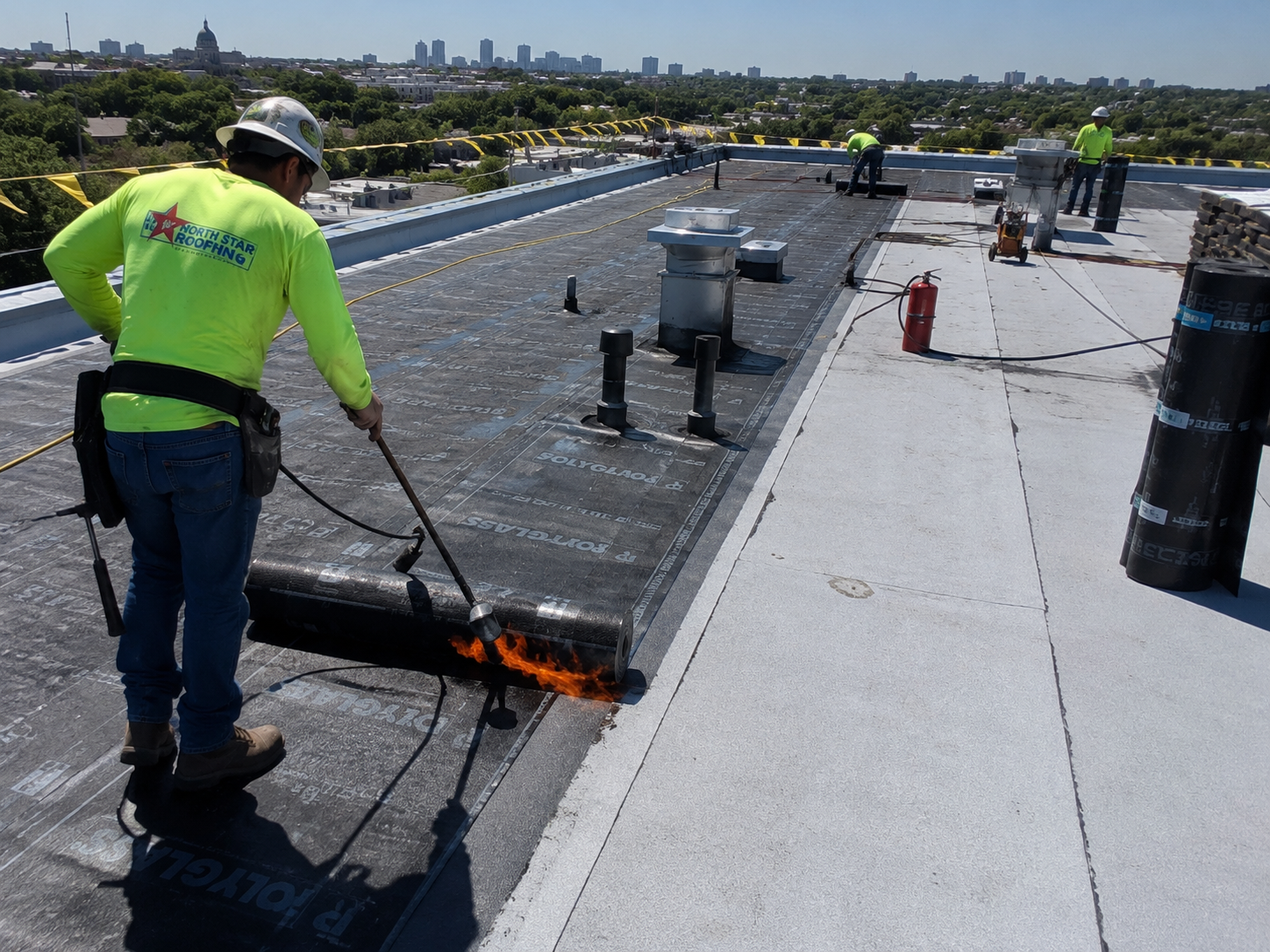
Modified bitumen roofing is an asphalt-based commercial roofing system manufactured in reinforced rolls. The asphalt is modified with polymers to improve flexibility, weather resistance, installation performance, and durability compared with traditional unmodified asphalt materials.
The membrane may contain polyester, fiberglass, or composite reinforcement. Depending on the system, the roof may include a base sheet, one or more reinforcing plies, and a finished cap sheet with a mineral-granulated, smooth, coated, or reflective surface.
Modified bitumen roofing can be installed using several methods, including torch application, cold adhesives, self-adhering membranes, hot asphalt, or approved mechanical attachment. The selected system should match the roof deck, building use, project conditions, safety requirements, drainage, and long-term property plans.
Modified bitumen roofing combines the familiarity of asphalt with reinforced membranes and modern installation options.
Modified bitumen assemblies may include several waterproofing, reinforcing, thermal, and structural layers designed to function as a complete commercial roofing system.
The top membrane provides the exposed weathering surface and may include mineral granules, coating, or a smooth finish.
Additional membrane layers may provide reinforcement and waterproofing redundancy beneath the finished cap sheet.
A compatible cover board can create a stable substrate and add resistance to impact, traffic, and construction activity.
Rigid or tapered insulation supports energy performance and may establish slope toward drains, scuppers, gutters, and outlets.
Steel, concrete, wood, gypsum, and other approved decks support the complete modified bitumen roofing assembly.
APP and SBS describe two common polymer-modification approaches. Each has different handling, flexibility, surface, and installation characteristics.
APP-modified bitumen combines asphalt with a plastic-type polymer. It is commonly associated with torch-applied membranes, although approved alternatives may also be available depending on the manufacturer and system.
SBS-modified bitumen combines asphalt with a rubber-like polymer. The resulting membrane is valued for flexibility and may be installed with cold adhesive, hot asphalt, self-adhering technology, torch application, or approved mechanical methods.
Modified bitumen membranes are installed in sheets with side laps, end laps, transitions, and flashing details. Each overlap must be prepared and bonded according to the selected material and installation method.
Poor adhesion, trapped moisture, insufficient heat, excessive heat, contamination, wrinkles, unsealed laps, unsupported transitions, and incompatible repair materials can reduce roof performance.
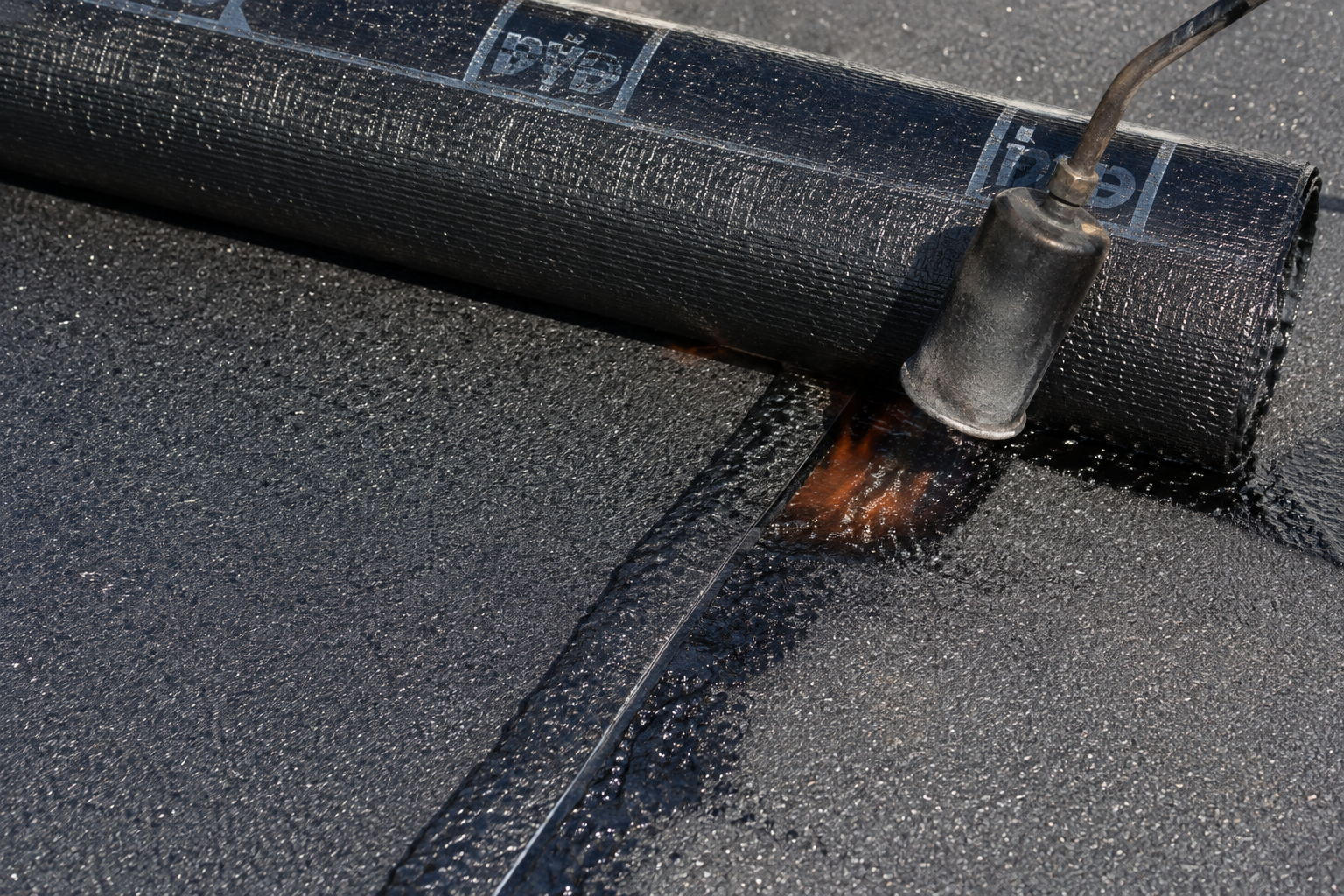
Modified bitumen is commonly considered for commercial properties that need reinforced asphalt roofing, layered waterproofing, maintainable details, and several installation options.
Multiple membrane layers may provide additional protection if the exposed surface receives localized damage.
Polyester, fiberglass, and composite reinforcement can improve membrane strength and resistance to normal rooftop conditions.
Polymer modification supports flexibility and performance across properly designed commercial roof transitions and details.
Reinforced membranes and cap sheets can provide a rugged surface for commercial roofs with planned maintenance activity.
Systems may be torch-applied, self-adhered, cold-adhered, mechanically attached, or installed using hot asphalt.
Compatible membrane, asphalt, adhesives, mastics, flashing, and reinforcement can be used for localized roof repair.
Modified bitumen is commonly evaluated for commercial buildings with flat or low-slope roofs, rooftop equipment, regular maintenance activity, compatible decks, and existing asphalt-based roofing.
Large roof areas with drains, equipment, penetrations, loading operations, and planned service access.
Shopping centers and individual properties with rooftop HVAC, curbs, drains, and occupied spaces below.
Professional properties requiring maintainable low-slope roofing, flashing, drainage, and equipment coordination.
Multifamily and HOA properties with flat-roof sections above occupied residential areas.
Operational buildings with service traffic, mechanical equipment, exhaust systems, and utility penetrations.
Classroom, administrative, cafeteria, and activity buildings with broad low-slope roof areas.
Sanctuary, classroom, office, and community buildings with commercial flat-roof sections.
Occupied properties requiring careful staging, drainage, equipment coordination, and project planning.
Installation should follow the selected membrane, manufacturer requirements, roof deck, building conditions, fire-safety planning, weather, access, and project specifications.
Controlled heat softens the membrane backing and bonds the sheet to the prepared substrate or underlying membrane.
A release film is removed to expose the membrane’s factory-applied adhesive before the sheet is positioned and rolled into place.
Approved cold-process adhesive is applied to bond membrane layers without torch application or hot asphalt.
Heated asphalt may be used to bond compatible membrane plies as part of an approved multi-layer roof assembly.
Each roofing system offers different materials, installation methods, surface characteristics, reinforcement, and maintenance considerations.
| System Feature | Modified Bitumen | Built-Up Roofing | TPO Roofing |
|---|---|---|---|
| Material Type | Polymer-modified asphalt membrane | Asphalt and reinforcing felts or fabrics | Thermoplastic single-ply membrane |
| Typical Layering | One or more reinforced membrane plies | Multiple asphalt and reinforcement plies | Single membrane layer over the roof assembly |
| Common Surface | Granulated, smooth, or coated cap sheet | Gravel, mineral surface, or coating | Smooth white or light-colored membrane |
| Installation | Torch, adhesive, self-adhered, or asphalt | Hot asphalt, cold process, or approved alternatives | Mechanically attached, adhered, or induction welded |
| Seam or Lap Method | Bonded asphalt membrane overlaps | Asphalt-embedded reinforcing plies | Heat-welded field seams |
| Common Commercial Use | Broad flat-roof application | Traditional multi-ply commercial roofing | Broad commercial single-ply application |
This comparison is general. Roof deck, existing materials, building use, drainage, fire-safety requirements, insulation, traffic, reflectivity goals, access, and long-term maintenance should be evaluated before selecting a roofing system.
Localized damage may often be repaired when the surrounding membrane, reinforcement, substrate, and insulation remain suitable for compatible corrective work.
Side laps, end laps, and transitions may open because of movement, contamination, poor bonding, or aging materials.
Weathering, aging, movement, and surface stress may create cracks that require inspection and compatible repair.
Trapped moisture, air, poor bonding, or application conditions may contribute to blistering and membrane separation.
Tools, service traffic, debris, equipment work, and sharp objects may damage the cap sheet or underlying layers.
Walls, curbs, drains, pipes, roof edges, and equipment transitions may require reinforcement or replacement.
Surface granules may loosen because of aging, foot traffic, weathering, drainage, or mechanical activity.
Drains, scuppers, gutters, low areas, and surrounding membrane may deteriorate or hold water.
Incompatible coatings, mastics, patches, loose membranes, and temporary repairs may need to be removed and corrected.
Routine inspection and maintenance can help identify developing cracks, open laps, damaged flashing, blocked drainage, loose granules, punctures, and deteriorated previous repairs.
Review membrane surfaces, laps, flashing, drains, penetrations, roof edges, equipment, and previous repairs.
Remove debris, vegetation, loose materials, contaminants, and conditions that interfere with drainage.
Keep drains, scuppers, gutters, overflows, and roof outlets clear and accessible.
Address open laps, cracks, punctures, flashing, blisters, edges, and failed previous work.
Track recurring roof conditions, moisture concerns, surface aging, traffic, repairs, and replacement needs.
A completed modified bitumen roof should provide bonded membrane plies, secure overlaps, reinforced flashing, clear drainage, dependable roof edges, protected penetrations, and accessible equipment-service areas.
Property owners comparing Los Angeles commercial roofing contractors should look for clear system guidance, compatible membrane materials, careful project planning, dependable flashing, proper drainage, and attention to the complete commercial roofing assembly.
Roofing recommendations should be based on the building, existing materials, deck, drainage, insulation, application requirements, roof traffic, equipment, access, and long-term property goals.
Modified bitumen is a reinforced asphalt-based roofing membrane enhanced with polymer modifiers. It is commonly installed on flat and low-slope commercial roofs.
APP uses a plastic-type modifier and is commonly associated with torch-applied systems. SBS uses a rubber-like modifier and may be installed using several approved methods, including self-adhered, cold-adhered, hot asphalt, or torch application.
It may be a strong option for many Los Angeles properties, especially buildings needing reinforced asphalt roofing, durable cap sheets, layered waterproofing, and repairable roof details.
Depending on the membrane and approved system, installation may use torch application, self-adhering membranes, cold adhesives, hot asphalt, or mechanical attachment.
Yes. Self-adhered, cold-adhered, hot-asphalt, and approved mechanically attached systems may provide alternatives to open-flame installation.
Localized laps, cracks, punctures, flashing, blisters, drains, and damaged surfaces may often be repaired using compatible materials when the surrounding roof remains suitable.
Modified bitumen uses factory-manufactured reinforced membrane sheets containing polymer-modified asphalt. Built-up roofing generally uses multiple field-installed layers of asphalt and reinforcing felts or fabrics.
A recover assembly may be possible in some situations. Existing roof layers, moisture, deck condition, insulation, attachment, drainage, compatibility, and local requirements must be reviewed.
Performance depends on membrane type, number of plies, installation quality, flashing, drainage, climate, roof traffic, repairs, inspection, and ongoing maintenance.
Pricing depends on roof size, removal, deck condition, insulation, membrane type, number of layers, installation method, flashing, drainage, access, equipment, and project complexity.
Tell us about the building, existing roof, roof size, deck, drainage, insulation, rooftop equipment, current leaks, repair history, replacement plans, and long-term performance goals.